
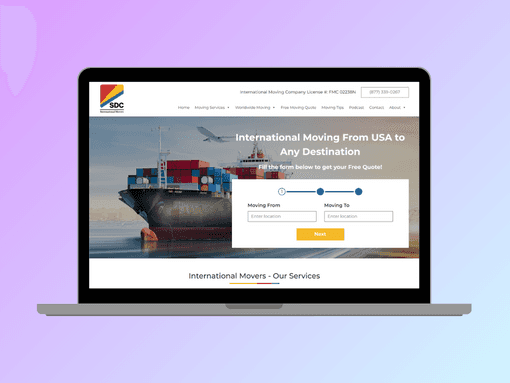
575% growth in non-brand organic traffic for an international mover

International moving and shipping company. We expanded their online presence to reach a broader audience and grow non-brand organic traffic.

Traffic
575%
Engagement
12 min
Client
SDC International
Industry
International moving and shipping
Region
International shipping corridors
Services
SEO Services, Content Marketing
SDC International International moving and shipping project cover image

Context

The context behind this work

Nobody searches for an international move in the abstract. They search from somewhere to somewhere. Origin and destination are the shape of the query, and everything the searcher wants to know sits inside that pairing. Customs rules, transit times, port options, documentation, what a container costs on that route. A general page about international moving answers none of it.

The vertical has a second feature that shapes the whole problem. Aggregators and lead brokers dominate the results. These sites do not move anything. They collect a form fill and sell it, sometimes to several companies at once, which is why a searcher who fills one in gets called by five firms. Because they publish at scale and cover every corridor, they outrank the companies actually operating the routes.

That leaves corridor demand specific and badly served. The searcher wants route-level detail from someone who runs the route. What they usually find is a generic quote form. For an operator with real corridor knowledge, that gap is the opportunity, provided the site is built in the shape the demand comes in.

The challenge

An offline reputation that search could not see

SDC International had years of reputation built through referrals and repeat business. Search told a different story. Someone searching a specific origin and destination pairing rarely found them, because the site had almost nothing built at that level.

The architecture was organised around services rather than routes. Sea freight, air freight, storage, packing. That is how the business describes itself internally and it is not how anyone searches. A person moving between two countries does not start from a service category. They start from the two countries.

So the site under-indexed for exactly the queries with the most intent behind them. Every corridor search went to an aggregator, and SDC entered the conversation later as one of several names on a list, competing on price against firms the searcher had no reason to distinguish from them.

Technical debt sat under all of it. Indexation problems meant parts of the site were not being read reliably, and crawl efficiency was poor enough that any large rollout would have been throttled from the start. Publishing into that state would have wasted the work.

What was at stake

  • Corridor demand was being captured entirely by competitors and aggregators.
  • Growth depended on referrals rather than a repeatable acquisition channel.
  • Technical issues capped the return on anything new that got published.
  • Real route expertise never reached the searcher who needed it.

The work

How we approached it

01

Technical cleanup

Remove the issues that would have throttled everything published after.

This came first, not last, and the sequence was the single most important decision in the project. A large page rollout multiplies whatever state the site is already in. If indexation is unreliable, publishing hundreds of pages produces hundreds of unreliable pages. If crawl efficiency is poor, new pages get discovered slowly or not at all, and by the time they are read the rollout has been judged a failure. Doing the cleanup afterwards also makes diagnosis impossible, because a page that is not ranking might be thin, or might be uncrawled, and there is no way to tell which. We fixed the indexation problems limiting coverage, improved crawl efficiency so new pages would be found quickly, and set up monitoring before a single corridor page went live. Only then did the rollout start.

  • Executed a technical SEO cleanup across the site
  • Fixed indexation problems limiting corridor coverage
  • Improved crawl efficiency ahead of the page rollout
  • Put monitoring in place before publishing began
02

Corridor architecture

Structure the site around how people actually search for a move.

Corridor architecture means organising the site by origin and destination pairing rather than by service line. Each corridor becomes an addressable place on the site that a searcher can land on directly. Above the corridors sit country and region level pages that group them, and beside them sit the service pages that explain how the move is executed. We prioritised corridors by real demand rather than building every possible pairing, because most permutations have no searchers behind them and publishing them creates volume without value. Then we set a template that could scale, which is harder than it sounds. The template has to hold the fields that genuinely differ per route while leaving room for detail that cannot be templated at all.

  • Built a corridor-based content architecture
  • Prioritised the origin and destination pairs with real demand
  • Set a template that could scale without duplicating content
  • Grouped corridors under country and region level pages
03

Programmatic destination pages

Cover corridor demand at scale without thin pages.

Programmatic pages fail when the only thing that changes between them is the place name. That produces a set of near-duplicates, and a search engine has no reason to index most of them. The fix is to work out what genuinely differs by route before building anything. For a moving corridor that means transit options and typical timings, the ports or hubs involved, customs and documentation requirements at each end, what people usually ship on that route and the practical constraints of the destination. Those are real differences, and they change the substance of the page rather than just its title tag. Each page also connects back to the service pages that explain how the move is carried out, so a corridor page does not have to repeat the operational detail and the service page gains links from every route that uses it. Corridors also link sideways to related routes sharing an origin or destination, which is how someone comparing two options moves through the site.

  • Shipped programmatic destination pages across target corridors
  • Gave each page distinct route detail rather than a swapped place name
  • Connected destinations to the relevant service pages
  • Linked corridors sideways to routes sharing an origin or destination

What we shipped

  • Corridor-based site architectureThe site reorganised around origin and destination pairings, grouped under country and region pages and joined to the service set.
  • Programmatic destination page systemA template built around the fields that genuinely differ by route, with space for detail that cannot be generated.
  • Technical SEO audit and fix logIndexation and crawl issues identified, fixed and verified before the rollout, with monitoring in place to catch regressions.
  • Corridor keyword and priority mapRoutes ranked by real demand and commercial value, so build order followed opportunity instead of alphabet.
  • Internal linking model connecting routes to servicesLinks from every corridor to the services it uses, plus sideways links between routes that share an origin or destination.

Outcome

Results

Traffic
575%

Growth in non-brand organic traffic, close to six times the starting point.

Engagement
12 min

Average engaged time across corridor and destination pages.

Non-brand organic traffic grew nearly six times over, with the biggest gains landing on high-intent moving queries. Corridor coverage turned search into a channel the business could plan around. The engagement figure matters as much as the traffic one. Twelve minutes on a route page means people are reading customs and transit detail rather than bouncing off a quote form, which is the behaviour that separates this from aggregator traffic.

How we work

What we hold to on this kind of work

Fix the foundation before you scale

A large rollout multiplies whatever state the site is in. Indexation and crawl work comes first, otherwise you cannot tell a thin page from an unread one.

Scale structure, never substance

Templates handle layout and the fields that genuinely differ. If the only thing changing between pages is a place name, the page should not exist.

Build in the shape of the query

Search follows how people describe their problem, not how a business organises its service lines. Architecture should match the first, then link to the second.

Want results like these?

Send us your goals and we will reply within one business day with the first three moves we would make.

Questions

Frequently asked

More case studies

Get a plan for your brand

Tell us where you are stuck. We come back within one business day with the first three moves we would make.

At least 25 characters and 4 words, so we can reply with something useful.0/1000

Certified partners

Meta certified partner badgeGoogle certified partner badgeSnapchat certified partner badgeShopify certified partner badge
No obligationReply within one business dayNDA on request

Prefer to talk first? Book a call