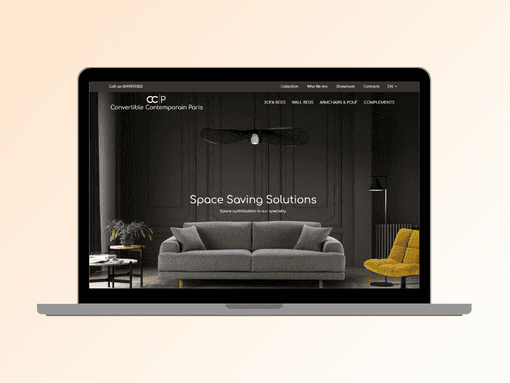
36% organic traffic growth for Italy's leading convertible sofa maker

Italy's leading convertible sofa maker. We wrote SEO-friendly service copy that drove more organic traffic to category and product pages.

Traffic
36%
Engagement
8 min
Client
Convertible Contemporain
Industry
Furniture retail, convertible sofas
Region
Italy
Services
SEO Services, Content Marketing
Convertible Contemporain Furniture retail, convertible sofas project cover image

Context

The context behind this work

Furniture is a considered purchase. The price is high enough that few people buy on a first visit, and the object stays in a room for years, so the comparison window stretches over weeks and often months. Shoppers return several times, from different devices, across different sessions, and each visit narrows the field slightly.

That comparison happens by attribute long before it happens by brand. Someone furnishing a small apartment searches by size, then by mechanism, then by material, then by the room it goes in. A sofa bed for a study is a different search from a sofa bed for a living room, even when the product is identical. Brand names enter late, usually once two or three options are already in play.

This is where large furniture catalogues run into trouble. Variant depth is a genuine advantage in a showroom and a liability in search. When a catalogue holds twelve near-identical pages for the same product in different fabrics, each one carries roughly the same words and targets roughly the same query. Search engines have to choose between them, the signals split across the set, and the page that gets picked is often not the one the retailer would have chosen.

The challenge

Near-identical pages competing with each other

The clearest problem was keyword cannibalization. Product variants that differed by fabric or colour carried close to the same copy and pointed at the same query. Instead of one strong page, the catalogue offered several weak ones, and the links, engagement and authority that should have concentrated on a single page were spread thin across the group.

The symptom is easy to recognise once you look for it. Rankings for a term move between URLs from week to week. Impressions spread across several pages that never quite reach the first page. The page a merchandiser considers the hero for a category is not the one search engines show.

Underneath that sat a second issue. Category and product pages were built to close a visit rather than to earn one. They worked well for a shopper who already knew the brand and arrived ready to browse. They said almost nothing to a shopper still comparing mechanisms and sizes, which is where most non-brand demand lives.

Convertible Contemporain had retail authority and a loyal base. People who already knew the name found them easily. Everyone else met a competitor first, at exactly the stage where preferences form.

What was at stake

  • Non-brand shoppers were meeting competitors first at the comparison stage.
  • Catalogue depth was working against the site instead of for it.
  • Growth stayed tied to brand awareness spend rather than compounding search demand.
  • Merchandising priorities and search visibility were pointing at different pages.

The work

How we approached it

01

Cannibalization audit and separation

Stop pages from competing with each other for the same query.

Cannibalization shows up when several URLs from one site chase one query and none of them consolidates the signals. We started by grouping every page in the catalogue by the query it appeared to target, then looked for clusters where multiple URLs collected impressions for the same term. Each cluster got one of three outcomes. Where two pages served genuinely different intents, we separated them by rewriting each around its own question so the overlap disappeared. Where a page existed only because a variant existed, and it had no distinct question behind it, we folded it into the parent and kept the variant as an option on that page rather than a page of its own. Where one page was clearly the strongest candidate, we made it the target and pointed the rest at it with internal links. The rule we applied throughout is simple. A variant earns its own page when someone searches for it specifically and needs information the parent page cannot carry. Colour rarely qualifies. Size, mechanism and material often do.

  • Grouped catalogue URLs by the query each was competing for
  • Separated overlapping pages so each answered a distinct question
  • Folded variants with no distinct demand back into the parent page
  • Chose one target page per query and pointed the rest at it
02

Intent-first category copy

Rebuild category pages around what shoppers actually search for.

Category and product pages should not do the same job. A category page serves the shopper still narrowing the field, so it needs to explain the differences inside the category, cover the attributes people filter by, and make comparison easy. A product page serves someone who has narrowed already, so it needs specifics, dimensions, mechanism detail and the reasons to choose this one over its neighbour. Most catalogues blur the two, giving categories a thin line of copy and products a paragraph of the same generic description. We rewrote category copy around comparison questions, mapped non-brand demand at the attribute level so each category knew which terms it owned, and reordered page structure to follow the way buyers narrow choices. Room, size, mechanism, then material. Adding more words was never the aim. Several pages ended up shorter.

  • Mapped non-brand demand across convertible sofa categories
  • Rewrote category copy to answer comparison questions
  • Aligned page structure with the way buyers narrow choices
  • Gave category and product pages clearly different jobs
03

Variant coverage and catalogue linking

Cover real variant demand, then connect the catalogue so authority reaches the right pages.

Once the overlaps were resolved, gaps became visible. There were attribute combinations shoppers searched for that had demand behind them and no page to meet it, usually around size and mechanism pairings. Those got built. Then the linking. In a catalogue, internal links are how a search engine learns which pages belong together and how a shopper moves between options they are cross-shopping. We linked categories to the variants people compare against each other, improved crawl paths into deeper product pages that previously sat too many clicks from anything with authority, and made sure every page offered a sensible next step. The result is a catalogue that reads as a connected set rather than a stack of separate listings.

  • Expanded coverage where real variant demand had no page
  • Shipped internal linking upgrades across the catalogue
  • Linked categories to the variants shoppers cross-shop
  • Improved crawl paths into deeper product pages

What we shipped

  • Cannibalization audit across the catalogueEvery competing URL grouped by target query, with a separate, merge or redirect decision recorded against each cluster.
  • Rewritten copy for core category pagesCategory pages rebuilt around comparison questions and attribute-level demand, with a clear split from product page content.
  • Expanded content coverage across product variantsNew pages only where an attribute combination had genuine demand and information the parent page could not carry.
  • Catalogue-wide internal linking upgradeLinks between categories, cross-shopped variants and deeper product pages, with shorter paths from authority to depth.
  • Page structure guidelines for new launchesA rule set covering when a variant deserves its own page, what belongs on a category page and how to avoid new overlap.

Outcome

Results

Traffic
36%

Growth in organic sessions after the category rebuild.

Engagement
8 min

Average time on site as shoppers found the right pages.

Organic sessions grew steadily and time on site climbed as buyers found the content they were actually looking for. Better matching, not more pages, did the work. Some of the gain came from pages we removed rather than pages we wrote, which is the usual pattern once cannibalization is the main constraint.

How we work

What we hold to on this kind of work

Consolidate before you create

When several pages chase one query, adding a new page makes the problem worse. We resolve the overlap first, then look at what is genuinely missing.

A variant needs a reason, not just a SKU

Its own page is justified when people search for it specifically and need detail the parent cannot carry. Otherwise it belongs as an option on the parent.

Categories compare, products decide

Category pages help a shopper narrow. Product pages help them commit. Keeping the two jobs separate stops both from reading the same.

Want results like these?

Send us your goals and we will reply within one business day with the first three moves we would make.

Questions

Frequently asked

More case studies

Get a plan for your brand

Tell us where you are stuck. We come back within one business day with the first three moves we would make.

At least 25 characters and 4 words, so we can reply with something useful.0/1000

Certified partners

Meta certified partner badgeGoogle certified partner badgeSnapchat certified partner badgeShopify certified partner badge
No obligationReply within one business dayNDA on request

Prefer to talk first? Book a call