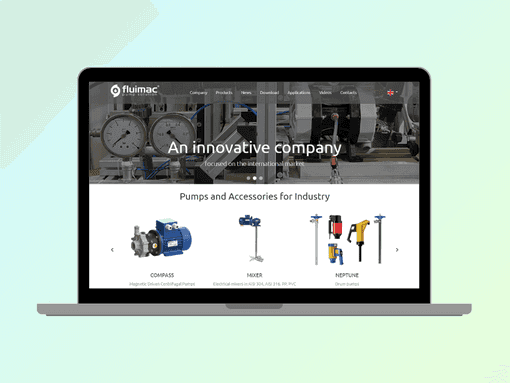
42% more organic traffic for an industrial pump manufacturer

Italian pump manufacturer. We rewrote service pages against buyer intent and rebuilt internal linking to lift organic search rankings.

Traffic
42%
Engagement
10 min
Client
Fluimac
Industry
Industrial manufacturing, pump systems
Region
Italy
Services
SEO Services, Content Marketing
Fluimac Industrial manufacturing, pump systems project cover image

Context

The context behind this work

Industrial B2B buying is slow and rarely happens alone. A pump purchase usually passes through a process engineer, a maintenance lead, a procurement officer and sometimes a plant manager. Each one cares about something different. The engineer wants chemical compatibility and duty point. Procurement wants lead time and total cost. Nobody signs on the strength of a brand line.

That changes how these buyers search. They type applications, not brand names. Flow rates, materials, viscosity, the fluid being moved, the environment it is being moved in. A first search is often a description of a problem rather than the name of a product. By the time a brand name gets typed, the shortlist already exists, and the vendors on it earned their place earlier in the research.

Manufacturer catalogues are usually written for the wrong moment. They read as reference material for someone who has already picked the supplier and now needs the specification. That is a real job, but it is the last job. It is why sites with genuinely deep engineering content often lose search to competitors with thinner products and better structured pages. The information exists. It is just not arranged for the question being asked.

The challenge

Deep product expertise that search engines could not read

Fluimac knew pumps better than almost anyone in their category. That knowledge sat on service pages written for engineers who already knew the brand, not for the buyers typing commercial queries into Google.

The pages read as specification sheets. They opened with product codes and closed with tables. Everything a buyer needed was technically present, but the page never named the application, the fluid or the problem in the words a buyer would use. Search engines match language to intent, and the language was pointed at the wrong stage.

The result was a mismatch between authority and visibility. Fluimac had the depth to be the best answer for a long list of application queries. The pages just never claimed those queries. Competitors with less product range wrote pages that named the use case plainly and took the position by default.

Internal linking made the gap wider. Product families sat in isolation, each one an island. Pages that had earned authority had no route to pass it to pages that needed it, so strength stayed stuck where it landed instead of spreading across the catalogue.

What was at stake

  • High-intent industrial queries were being handed to competitors by default.
  • Real product depth was invisible to buyers doing early research.
  • Every new page added to the site inherited the same structural weakness.
  • Sales conversations started later in the cycle, after a shortlist had formed elsewhere.

The work

How we approached it

01

Topical mapping

Understand exactly what pump buyers search for and where Fluimac could realistically win.

A topical map is not a keyword list. It is a model of a subject area, broken into the questions a buyer asks and the order they ask them in, with a page assigned to each one. For pumps that means starting from applications and fluids rather than from product families, because that is the level buyers think at. Once the map exists, gaps become obvious. So do overlaps, where two pages were built to answer the same question and neither one does it fully. We grouped by intent instead of sorting by volume, because volume tells you how many people search and intent tells you what they want. A high volume query at the wrong stage brings visits that never reach a quote. A lower volume application query brings someone who is specifying a pump this quarter. Ranking opportunities were then ordered by commercial value against realistic difficulty, so early work landed where it would pay back first.

  • Built a full topical map across pump applications and product families
  • Grouped queries by buyer intent rather than by product code
  • Ranked opportunities by commercial value, not raw volume
  • Identified overlaps where two pages competed for one question
02

Service page rewrites

Turn specification pages into pages that answer buying questions.

The rewrite had one constraint above all others. Engineering accuracy could not move. In technical categories a wrong tolerance or an imprecise material claim costs more than a lost ranking, so nothing in the specification layer was rephrased for readability. Instead we changed what surrounds it. Each page now opens by naming the application and the problem in plain language, then narrows into the technical detail that was always there. Headings were rebuilt to follow the sequence of a buyer's questions rather than the structure of an internal catalogue. One page took one job. Where a page had been trying to serve three applications at once, it was split, because a page that half answers three questions ranks for none of them. The specification tables stayed exactly as engineering wrote them.

  • Rewrote every core service page against the mapped intent
  • Kept the technical depth, added the context buyers needed
  • Structured headings and copy so each page targeted one clear job
  • Split pages that were trying to serve several applications at once
03

Internal link architecture

Move authority from strong pages to the pages that needed to rank.

Internal linking matters more on a deep product catalogue than it does on a small site. On a ten page site, everything is one click from everything else and the structure takes care of itself. On a catalogue with hundreds of product and application pages, most pages sit several clicks from anything with authority, and crawlers reach them rarely or not at all. Links are also how a search engine works out which pages relate to which, so a catalogue with no cross linking reads as a pile of unrelated documents rather than a body of expertise on one subject. We connected product families through contextual links that a reader would actually use, tightened the paths between related applications, and removed dead ends where a page offered a visitor no next step. Anchor text described the destination rather than repeating a generic phrase.

  • Connected product families with deliberate contextual links
  • Tightened navigation paths between related applications
  • Removed dead ends that trapped both crawlers and readers
  • Used descriptive anchor text pointing at the target topic

What we shipped

  • Topical map for the full pump catalogueEvery application and product area broken into the questions buyers ask, with one page assigned to each and gaps marked for later.
  • Rewritten copy for every core service pageIntent-led openings and buyer-facing headings wrapped around the original technical specification, which was left untouched.
  • Internal linking plan across product familiesA link model connecting related applications and product families, with descriptive anchor text and no dead ends.
  • Intent-mapped keyword set with priority orderQueries grouped by buying stage and ranked by commercial value against difficulty, so the sequence of work was clear.
  • On-page structure and heading guidelinesA short standard for new pages covering heading order, one job per page and where technical detail belongs.

Outcome

Results

Traffic
42%

Growth in organic traffic as rewritten service pages started ranking.

Engagement
10 min

Average engaged time on the rewritten service pages.

Organic traffic and engagement climbed steadily as the rewritten service pages started ranking on the first page for high-value commercial queries. The gain came from matching real buyer intent, not from publishing more. Engaged time is the number worth watching here. In industrial categories a visitor who stays ten minutes is reading specifications, not skimming, and that behaviour is what tends to precede an enquiry.

How we work

What we hold to on this kind of work

Accuracy outranks phrasing

In technical categories the specification layer is not ours to rewrite. We change how a page opens, how it is structured and what surrounds the detail. The numbers stay as engineering wrote them.

One page, one job

A page built to answer three questions answers none of them well. Where scope is unclear we split rather than stretch, then link the parts together.

Fix structure before adding pages

New content inherits whatever structure it lands in. Rewriting and linking what already exists usually returns more than publishing more of the same.

Want results like these?

Send us your goals and we will reply within one business day with the first three moves we would make.

Questions

Frequently asked

More case studies

Get a plan for your brand

Tell us where you are stuck. We come back within one business day with the first three moves we would make.

At least 25 characters and 4 words, so we can reply with something useful.0/1000

Certified partners

Meta certified partner badgeGoogle certified partner badgeSnapchat certified partner badgeShopify certified partner badge
No obligationReply within one business dayNDA on request

Prefer to talk first? Book a call